
Scientific journal covers
Scientific Journal Covers: From Research Finding to Cover Art
A scientific journal cover gives an issue a visual identity and offers readers a way into the research behind it. Here’s how to choose a defensible concept, design it for the journal, and prepare it for submission.
What is a scientific journal cover?
A journal cover is editorial artwork for an issue, in print or online. A cover may interpret a featured paper or bring together the theme of a special issue. It can be an illustration, a photograph, or a composite. A manuscript figure presents evidence in enough detail for readers to inspect it. A graphical abstract gives a compact overview of one paper. A cover typically takes one idea from the research and turns it into a visual that can stand on its own beside the journal’s masthead.
Why a journal cover matters to the paper and its authors
It gives readers a reason to open the paper. If selected, the cover gives the study a prominent visual entry point in the issue. Someone scanning a journal’s website can recognize the subject, grasp why it might be relevant, and decide to read the abstract. This is especially valuable when the paper describes a mechanism or an interaction that is difficult to picture from the title alone.
It helps people outside the specialty understand the finding. A well-chosen visual can make the subject of a study recognizable to collaborators in other fields, university communications teams, and journalists. An accurate caption then connects the image to the specific result and gives those readers a starting point for explaining it to others.
It gives the research team an image it can use beyond the issue. With the appropriate rights and credits, a lab can use the artwork in a press release, conference talk, project website, or social post that links back to the paper. The same image can be adapted for those formats even if the journal selects another cover. If you plan to reuse it, agree on the formats and usage rights when you commission the illustration.
Cover selection is an editorial decision. Its value is the opportunity to put the research in front of more people and give them a clear way into the paper. Nature’s cover guide also describes ways authors can use cover artwork to communicate their research beyond the journal.
Begin with the result and its limits
Write one sentence that names the system, the change, and the observation. Then separate what the paper demonstrates from what the authors propose. In an oncology paper, for example, a decrease in a signaling marker in cultured cells can be represented at the cellular level. A picture of a tumor disappearing in a patient would imply a clinical outcome that the experiment did not test.
Identify the details that must survive stylization. These could be the position of a receptor relative to a membrane, the geometry of a material, or the interface where two substances interact. Color, scale, and perspective can be adjusted for the composition. The underlying relationship should still be recognizable when the authors review the sketch.
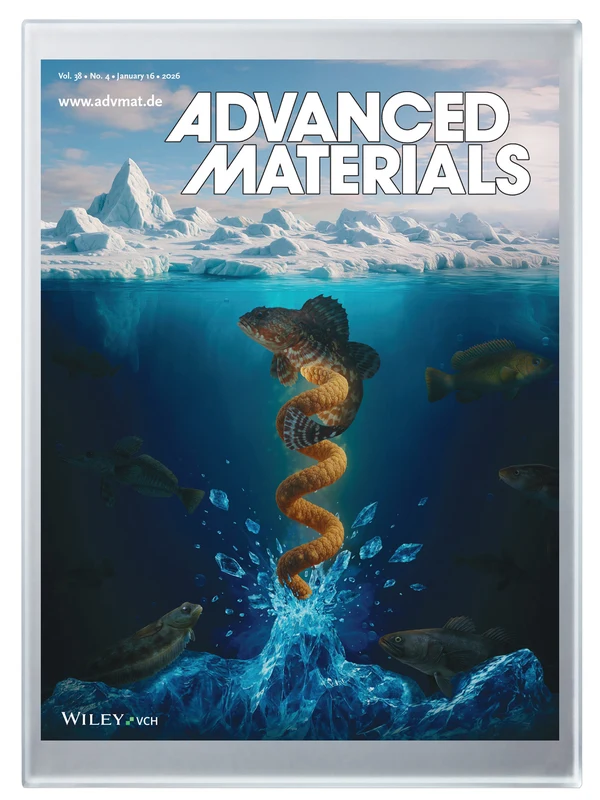
A portfolio example: antifreeze polypeptides
For the Advanced Materials cover shown here, the polar fish and ice introduce the biological inspiration for the study. The work itself concerns synthetic polypeptides inspired by fish antifreeze proteins and their ability to inhibit ice crystal growth. That distinction matters. The fish provides context for the design, while the caption can identify the material actually tested and the process the study investigates. See the issue and its cover description.
Design for the issue and the thumbnail
Check the specific journal’s rules before developing the artwork. Confirm whether it accepts cover proposals, what kind of placement is available, and when and how to submit. Ask for the template, dimensions, file format, and caption and credit requirements. Leave room for the masthead, issue information, and any cover lines. ACS Publications directs authors to the guidelines for their specific journal.
Review the design at two sizes. As a thumbnail, it should have a clear focal point and a legible silhouette. At full size, the material, anatomy, or setting can carry more detail. Check both views with the publisher’s crop in place so the feature that explains the concept remains visible.
What to avoid
- Generic science imagery. A glowing helix or an anonymous cell can obscure what is distinctive about the paper. Use an object, structure, or process a reader could connect back to the research.
- Visual claims beyond the evidence. An arrow can imply causation, a contact can imply binding, and a before-and-after view can imply an effect. Check what each visual cue communicates.
- A figure crowded into a cover. Multiple panels, long labels, and full legends compete with the masthead. Use the cover caption for the context that the image cannot carry comfortably.
- Unclear image rights. Check permission to adapt reference material and agree on credits and reuse with the journal before submitting.
What to send your illustrator
Share the abstract or relevant manuscript excerpt, a plain-language statement of the main result, and one or two figures that support it. Add the target journal, its cover specifications, the submission deadline, and any elements the image must show or avoid. Have a coauthor familiar with the mechanism review the concept sketch before it moves to final artwork.